.png)
Benefits to commercial landlords
1. Increase rental yield via premium rent per m²
Commercial tenants demand lower operating costs and are more environmentally conscious. By reducing tenant energy expenses, landlords can justify higher rent per square metre, translating to improved yield and higher asset value. As electricity costs continue to climb, solar becomes a compelling differentiator.
2. Green Star accreditation & sustainability leadership
Green Star-certified buildings not only score higher on sustainability assessments but also attract quality long-term tenants, investors, and premiums. Solar installations contribute directly to Green Star credits, showcasing your site’s commitment to energy efficiency, carbon reduction, and environmental stewardship. A significant number of Developers and Landlords are now putting this into practice retrofitting existing buildings and incorporating solar into New Builds. For example, to help achieve a 5-Star Green Star rating a commercial building with 350,000 kWh annual demand might install a 100–150 kW solar system providing 150,000 kWh/year (40% offset).
3. Lower tenant energy bills - A clear win-win
Commercial solar helps tenants by:
- Reducing grid-sourced energy costs
- Offering price predictability amid volatile tariffs
- Improving tenant retention and satisfaction
ZEN Energy’s guide explains that building owners with daytime-heavy loads gain most, as solar offsets peak consumption — stabilising costs and strengthening tenant relationships.
4. Help tenants meet carbon reduction targets
More businesses are pledging net-zero and sustainability commitments. By leasing from solar-enabled buildings, tenants can more easily measure and reduce their operational carbon footprint. Solar ownership lets you play a direct role in their ESG achievements, and make your property more attractive to eco-conscious occupiers.
5. A strategic investment with strong returns
Solar isn't simply a green gesture, it's a strategic lever to:
- Stabilise or reduce energy budgets
- Increase property asset value
- Enhance market positioning through sustainability
With smart financing (e.g., lease structures or PPA models), landlords can achieve positive cash flow and return on investment while keeping capex low.
Barriers for Tenants
The primary barrier for commercial solar tenants is the split incentive problem, where the landlord owns the building but the tenant pays the utility bills. This creates a situation where the landlord has little incentive to invest in a system that primarily benefits the tenant's bottom line.
Common barriers for commercial tenants include:
- Lease Term Mismatch: Commercial solar systems are long-term investments (25+ years), but most commercial leases are much shorter (often 3–10 years). Tenants are often reluctant to pay for a system they may have to leave behind or remove at the end of their lease.
- Structural and Roof Constraints: Older commercial buildings may have roofs that cannot support the weight of solar panels (3–6 lbs/sq ft) or may require replacement before the solar system's lifespan ends. Tenants may also be responsible for roof maintenance under "triple net" (FRI) leases, and adding solar can complicate or void roof warranties.
- High Upfront Costs: Capital expenditure for commercial-scale systems typically ranges from $1,500 to $2,000 per kW. This high initial cost, combined with long payback periods, can be a major deterrent for tenants with limited capital.
- Grid and Utility Hurdles: Obtaining "permission to operate" from local utilities can be the most time-consuming part of a project. Grid connection delays and the cost of potential electrical upgrades frequently stall installations.
- Complex Legal and Insurance Requirements: Most leases require a "Licence to Alter" and detailed legal agreements to define who owns the equipment and who is liable for potential damage or fire risks. Landlords often require tenants to increase their insurance coverage to account for these risks.
- Lack of Awareness and Education: Many businesses lack technical knowledge regarding the actual costs, benefits, and installation processes, leading to risk aversion
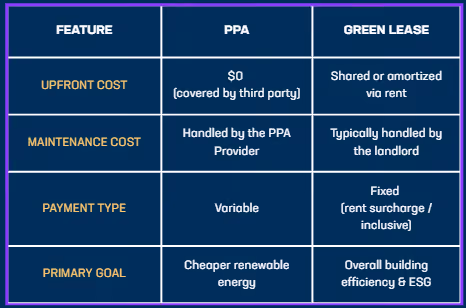
Both Power Purchase Agreements (PPAs) and Green Leases are designed to overcome the split incentive problem by aligning the financial and environmental interests of landlords and tenants.
Power Purchase Agreements (PPAs)
- How it works: The tenant (or building owner) agrees to purchase the electricity generated by the system at a predetermined rate per kilowatt-hour (kWh).
- Key Benefits:
- Zero Upfront Cost: The third-party provider covers all capital expenditures, including design, permitting, and installation.
- Immediate Savings: The agreed PPA rate is typically 10%–30% lower than standard grid tariffs.
- Performance Guarantee: Because the provider only makes money when the system produces power, they are responsible for all maintenance and monitoring.
- Flexible Terms: Contracts usually last 10–25 years, often with options for the tenant to buy the system at the end of the term.
Green Leases
A Green Lease is a standard commercial lease with added clauses that incentivise both parties to improve the building's energy performance.
- How it works: It includes specific provisions for cost-sharing of sustainability upgrades. For example, if a landlord installs solar, they can recover the capital cost through a small rent increase that is offset by the tenant's lower utility bills.
- Key Clauses:
- Cost Recovery/Amortization: Allows landlords to pass through the cost of solar installations to tenants, provided the tenant sees a net saving on their energy bills.
- Data Sharing: Requires both parties to share utility data to track progress toward carbon reduction or ESG (Environmental, Social, and Governance) targets.
- Sustainable Fit-outs: Mandates that any tenant renovations meet specific energy efficiency standards
Typical ROI in the NZ market
Return on Investment (ROI) and Payback Periods
- System size: 100 kW – 500 kW common for commercial roofs
- Payback period: 4-7 years (depending on usage & export assumptions)
- IRR (Internal Rate of Return): Often between 15–25%
- Savings: Typically 20–40% reduction in electricity costs annually
- System lifespan: 25–30 years for panels; 10–15 for inverters
Final Takeaway
For landlords, commercial solar offers a multi-dimensional payoff:
- Financial upside through higher rent and asset appreciation
- Tenant upside via lower utility costs and ESG alignment
- Market advantage with sustainability credentials and leasing appeal
If you're looking to unlock better returns and tenant retention, now is the moment to explore solar. With current technology and financing models, it’s a win for both landlord and tenant, and a meaningful step toward a cleaner, more resilient built environment.
Talk to Luke Mitchell from ZEN today for a free feasibility study on your building/s.
021 248 6086

.avif)