.png)
.webp)
.webp)
.webp)
ON FARM RESILIENCE TO MITIGATE ANIMAL WELFARE
For many kiwi farmers, solar energy has shifted from a curiosity to a genuine business decision, and the numbers are making that conversation easier every year. Edward and Angeline Hardie, who run Orcada, a 700-cow dairy operation outside Kaeo in Northland, made the switch to solar at the beginning of 2026. Their farm is now running on predominantly solar energy, monthly power costs are down 80%, and on a clear summer’s day they are generating close to everything they need.
Resilience for when the grid fails
Northland farmers know what it means to lose power for days after extreme weather events, like cyclones and floods. Hardie's farm was experiencing up to three outages a year before the installation. Each one created real risk and concern: uncontrolled vat temperatures, lack of wash down capability and hygiene issues, and most critically, 700 lactating cows that needed milking regardless of what the grid was doing.
"You can claim insurance on milk. But if you've got 700 cows that are lactating and you can't milk them, that's animal welfare."
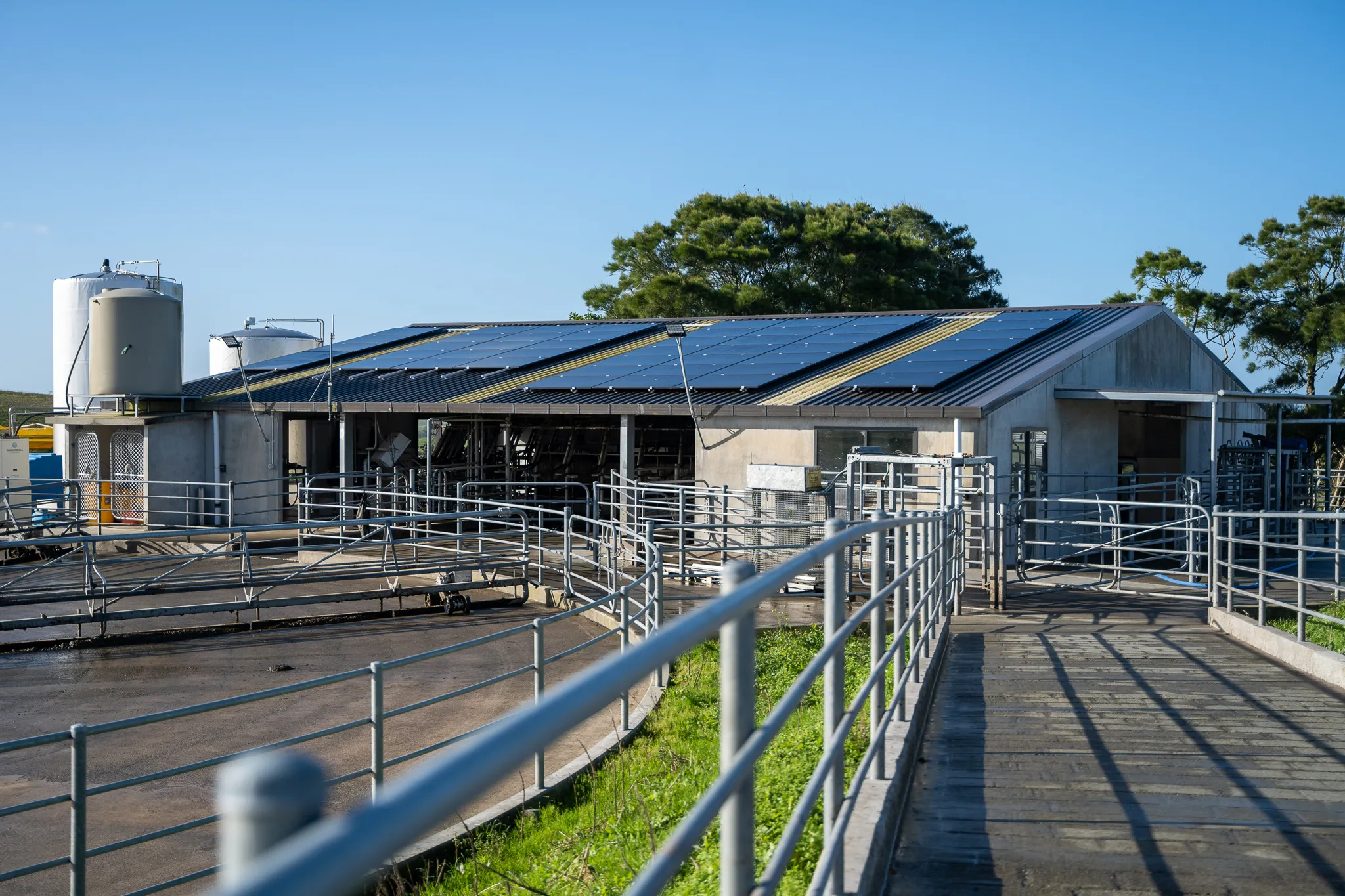
The system, combining rooftop panels, ground-mount arrays, and a Pylontech A100 battery (the first installed in New Zealand), changed that calculus entirely. When the grid goes down, Orcada keeps running. The battery stores enough charge to power at least one full milking, with the panels topping it up from first light. The cows get milked. The risk is mitigated.
Products
- 68.4kW System, with 104kWh battery
- 1 x Pylontech Optimum A100 Battery with 50kW Solis inverter
- 144 x LONGi Panel 475W Explorer
- Premium Schletter rails
A system built around your farm
What matters is designing a system around how a farm’s operation actually works, when farmers use energy, how reliable the grid connection is, and what they are actually trying to achieve.
That's the approach ZEN took with Hardie. Before recommending anything, ZEN spent time understanding the shape of the farm's energy demand: the early-morning milking spike, the seasonal variation, the resilience requirements.
"They were willing to take time answering my questions and personalising the solution for our farm."
The result is a system that Hardie actively manages through an app: monitoring generation, storage, and consumption in real time and adjusting how much he stores versus sells depending on the weather forecast. It's solar that works with a farming mindset, not against it. Surplus generation doesn't go to waste either. Any energy Hardie's farm doesn't use gets sold back to the grid, turning a cost centre into a partial revenue stream.
Hardie had been thinking about alternative energy since they bought the farm in 2011. What changed wasn't his interest, it was the economics.
For farmers still weighing it up, his advice is straightforward, “look at your own situation, work out what you're trying to achieve, and then find the system that fits. The pricing is compelling. The resilience is real. And the technology, properly designed, will outlast the next decade of whatever the New Zealand climate has in store.”